

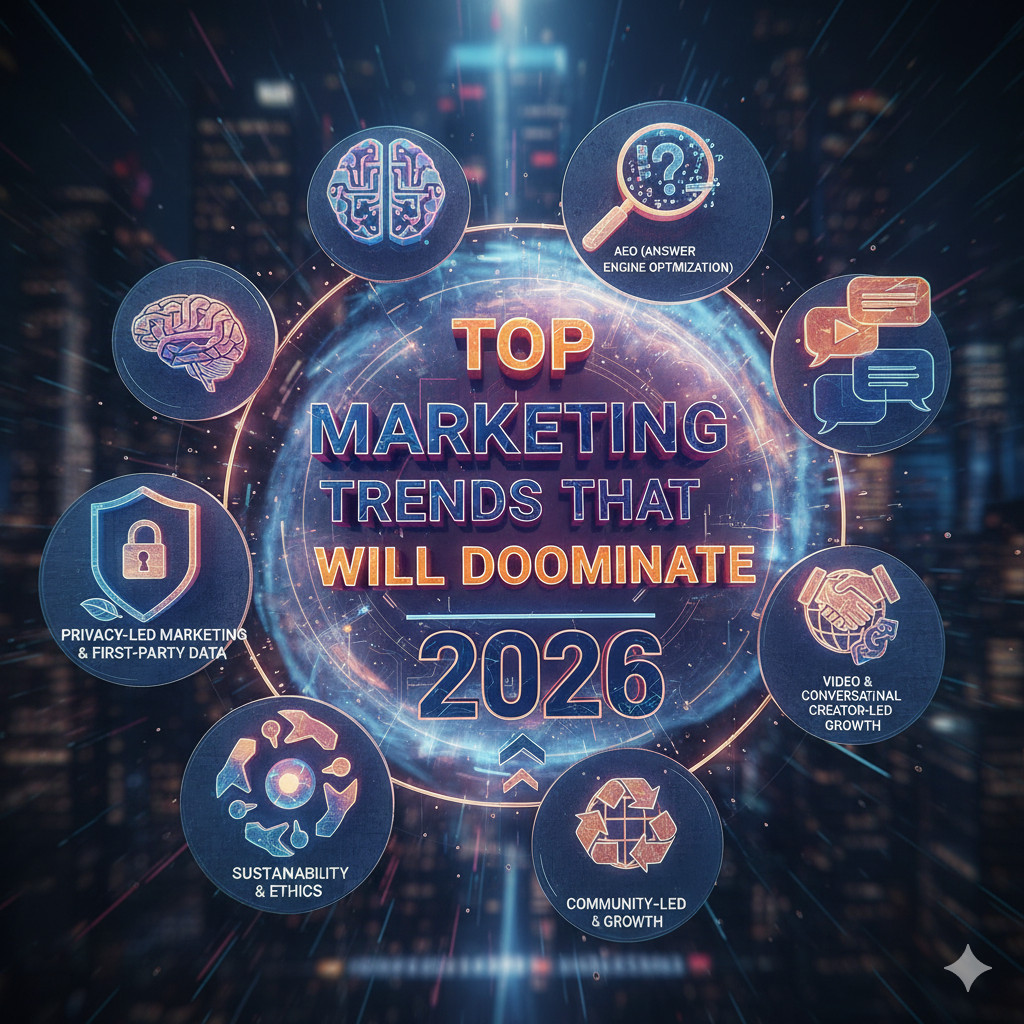
The marketing landscape is undergoing its most profound transformation in decades. As we move toward marketing trends 2026, the era of generalized, reactive campaigns is ending. The next wave of success will be defined by Intelligent Experience (IX): the strategic blend of AI automation, hyper-personalization, deep privacy compliance, and human-centric content that anticipates customer needs.
Marketers who thrive in this environment won’t just adopt new tools; they’ll fundamentally restructure their strategies around trust, conversation, and real-time adaptability. The following trends represent the major shifts that will separate the market leaders from the laggards in the coming years.
1. The Generative AI Leap: Tool to Autonomous Agent 🤖
In 2026, Artificial Intelligence moves beyond basic content generation and simple automation to become an autonomous, agentic partner. It’s not just generating copy; it’s running the campaign.
AI as the Strategic Core – Marketing Trends 2026
AI will cease to be a bolt-on tool and will be integrated into the core of the marketing stack:
- Predictive Campaign Optimization: AI agents will autonomously manage ad budgets, adjust bids, and refresh creative based on real-time performance. They will move from reactive systems to predictive marketing—forecasting outcomes and adjusting strategy before a campaign even launches.
- Hyper-Personalization at Scale: Traditional segmentation by demographics will be replaced by AI-driven real-time behavioral analysis. This enables true 1:1 personalization, where website content, product recommendations, and email copy adapt instantly based on a user’s current micro-moment intent.
The Rise of AEO -Marketing Trends 2026
Traditional SEO focused on optimizing content for blue links on a Search Engine Results Page (SERP). The dominant trend for 2026 is Answer Engine Optimization (AEO), a strategy focused on being the authoritative source for the AI-generated answers provided by platforms like Google’s AI Overviews, Gemini, and other Large Language Models (LLMs).
- Focus on Clarity and Structure: Content must be semantically tight, factually sound, and structured with clear, quotable summaries to be easily ingested and referenced by an AI.
- Zero-Click Dominance: Marketers must accept that many users will receive their answer directly from the AI. The goal is the brand’s authoritative inclusion in the generated summary, building awareness even without a click.
2. Privacy-Led Marketing and First-Party Data Imperative 🔒
The final obsolescence of third-party cookies, combined with increasingly strict global regulations (like the GDPR and the anticipated EU AI Act), forces a complete overhaul of data strategy.
Trust as the New Currency -Marketing Trends 2026
Privacy is no longer a compliance burden; it is a brand trust signal. Customers are willing to share data, but only when it provides clear, reciprocal value.
- First-Party Data is Gold: Brands must double down on collecting first-party data—data gathered directly from their audience through loyalty programs, email sign-ups, interactive website experiences, and community platforms. This data is the most reliable, compliant, and future-proof foundation for personalization.
- Ethical Transparency: Companies must be fully transparent about how and why they use AI and customer data. Explicit consent and easy opt-outs will be essential, and AI-generated content may require clear disclosure to maintain consumer trust.
3. The Fragmentation of Search and the Shift to Video/Conversational Interfaces 🗣️
Search is no longer confined to typing keywords into a browser. Discovery is fragmented across social platforms, generative AI interfaces, and connected devices.
Short-Form Video as the Discovery Engine
Platforms like TikTok, YouTube Shorts, and Instagram Reels have evolved from entertainment channels to primary search and discovery engines, especially for younger generations.
- Format-First Content: Content strategy must be format-first, matching the medium to the moment. Short, snackable video clips act as the ‘appetizer’ for discovery, linking to long-form content (the ‘full meal’) on owned channels (blogs, podcasts, long-form video) for building deep loyalty and E-E-A-T (Experience, Expertise, Authoritativeness, and Trustworthiness).
Voice and Multimodal Search Optimization
As AI assistants and smart home devices proliferate, marketing must be optimized for natural, conversational language.
- Focus on Long-Tail and Questions: Content should directly answer customer questions using full, natural sentences rather than singular keywords to align with how people speak into voice assistants.
- Visual Search Readiness: Ensure all product images are high-quality, clearly tagged, and optimized for visual search functions (like those on Google Lens and Pinterest), preparing for a world where people shop by image instead of text.
4. Community and Creator-Led Growth 🌱
The relentless pursuit of ‘followers’ gives way to the focus on high-value, high-engagement ‘communities.’ In an age of AI-generated content saturation, the human element—specifically genuine experience—is the greatest differentiator.
- Community Building: Brands will invest in closed, high-value communities on platforms like Discord or exclusive Slack/WhatsApp groups. These spaces turn customers into advocates, creating defensible marketing channels that generate valuable first-party data and feedback.
- Micro-Creator Partnerships: The focus shifts from costly mega-influencers to micro and nano-creators with smaller, highly niche, and deeply engaged audiences. Their authenticity and relatable content drive higher trust and conversion rates than traditional brand advertising.
5. The Sustainability and Ethics Check ♻️
Consumers, particularly Gen Z, increasingly demand that brands not only talk about social responsibility but demonstrate it through transparent action. Greenwashing will be swiftly called out.
- Action-Oriented Marketing: Campaigns tied to measurable, real-world impact—reduced packaging, ethical sourcing, community support—will cut through the noise.
- AI Governance and Ethics: Brands must adopt clear guidelines for AI usage, ensuring it does not perpetuate bias or violate privacy. Ethical, responsible AI implementation is a non-negotiable component of brand equity in 2026.
The future of marketing is intelligent, personalized, and built on trust. By embracing AI as a partner, prioritizing first-party data, and creating content optimized for the new fragmented search landscape, your brand will be positioned to dominate in 2026 and beyond.